Quote.
Organization name in, exposures out, under 60 seconds. The first desk to quote usually wins the account.
Questionnaires tell you what the applicant believes, or wants you to believe.
Ratings tools watch from a distance and guess.
Post-breach investigations keep finding the same thing: the application said MFA everywhere, and the compromised VPN account had none.
You've been pricing risk on the applicant's word.
There's finally a second source.
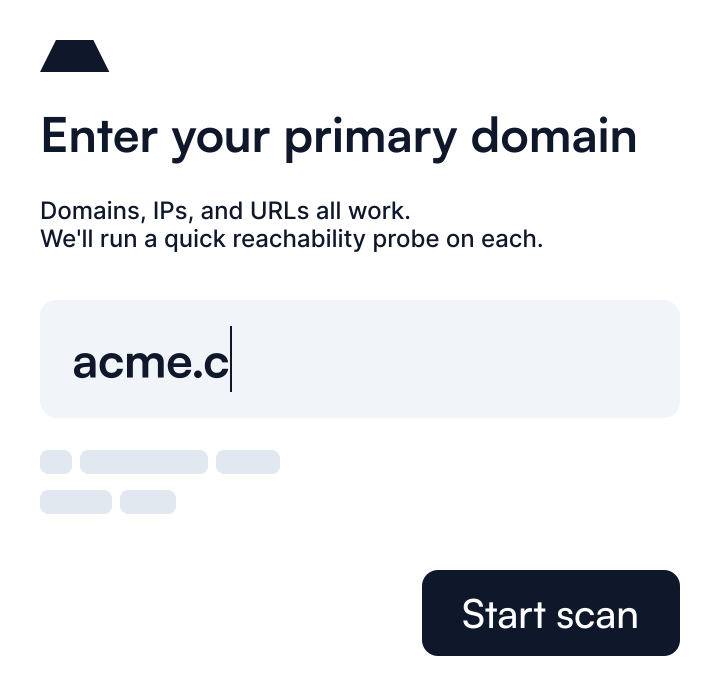
Type a domain and the applicant's real footprint renders in seconds, including the acquired subsidiary the application never mentioned.
A FIRE (Financial Risk Exposure) is a CVE with documented financial loss behind it, identified from the same class of actuarial data your desk already trusts to price policies.
290,000 loss cases across three decades stand behind every FIRE designation.
Organization name in, exposures out, under 60 seconds. The first desk to quote usually wins the account.
Upload the application; we check every externally verifiable answer against the real perimeter (ports, gateways, WAF, MFA signals, mail security) and link each discrepancy to the live asset. Internal-only controls come back marked unverifiable, never waved through.
Twelve months of daily scan history on every account. Consistent posture and clean-streak history make renewal simple and rate justification easier.
When a new CVE causes its first loss anywhere in the world, it enters the FIRE catalog and reaches every insured on your book within 24 hours.
One breached customer becomes a canary in the coal mine for all the rest: when one account files a claim, we automatically show you which policyholders are exposed to the same CVE.
We run authorized checks and confirm each finding on a live asset, per vulnerability, yes or no. When you send a remediation request, you can show the policyholder the exposed asset.
We offer a warranty of up to $5M to back our own findings. The warranty sits alongside your policy rather than competing with it.
The FIRE catalog comes from DFIR loss records, the same types of data your desk uses to price policies. Your scanner and your loss model finally agree about which vulnerabilities matter.
Published CVEs are headed past 200,000 a year. A CVE joins the FIRE list when it causes a documented loss, so your scanning stays focused even as AI vulnerabilities flood the CVE list.
Part of our team built the scanning stack inside a leading cyber insurer, so we know what your desk needs to see. Bring us a few of your accounts: in about 30 minutes we'll map their real exposure, show the FIREs on each, and show you what the application would never have told you.
Book a Demo